
Brian Damage
A gimmick is something that is intended to hook the attention of fans to a wrestler. They may be outrageous or steeped more in reality. Whatever the case may be, some have succeeded and many others have failed. The Gimmick Table takes a look at the origins of some of your favorite and not-so-favorite gimmicks of professional wrestlers.
Today we browse the gimmick of Hakushi
In 1994, Vince McMahon was in search of a Japanese talent to join the World Wrestling Federation. His first choice was to sign the legendary Hayabusa, who did have aspirations of one day working for the WWF. At the time, Hayabusa rejected the offer feeling the timing was not right and felt loyalty to Atsushi Onita and the FMW promotion. The WWF went on tour in Japan and sent executive JJ Dillon to scout wrestlers. It was during a show for Michinoku Pro where Dillon discovered a wrestler named Jinsei Shinzaki.
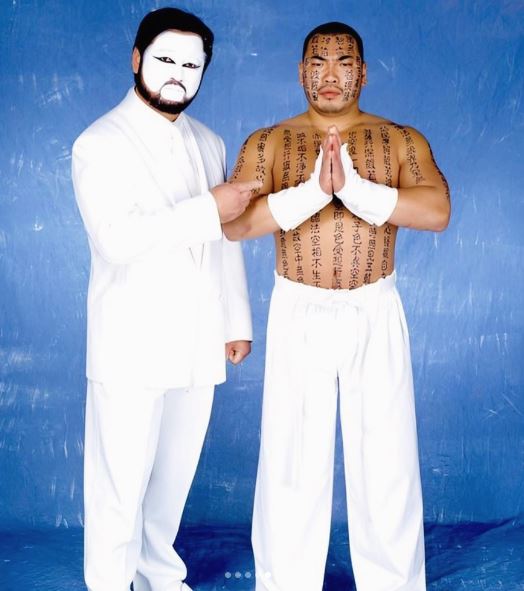
Shinzaki had a gimmick where he portrayed a mystical character that wanted to place a curse on the Great Sasuke. He was silent, worked a slower style and wore all white. It was Shinzaki himself who came up with the gimmick. Dillon saw this character and immediately sent tapes to Vince McMahon. The tapes showed Shinzaki walking the top rope similar to the Undertaker. Shinzaki also worked against smaller wrestlers and looked bigger than what he actually was. He actually stood 5 ft 11in tall and weighed 230 pounds. The WWF offered Shinzaki a deal and he accepted.
Bruce Prichard recalled seeing Shinzaki in person in Stamford, Connecticut for the first time and saw that he was smaller than they expected. Vince seemed disappointed, as the idea was to use Shinzaki’s Michinoku Pro gimmick in the WWF and be the anti Undertaker and eventually work a program with him. McMahon had doubts seeing his smaller size, but continued his current gimmick and named him Hakushi which translated to ‘White Paper.’ In Buddhism, it meant a state of emptiness achieved through meditation, which is considered a prerequisite for enlightenment. They added to his gimmick by giving him Buddhist writings on his face and body.
Since Hakushi did not speak English, McMahon hired Akio Sato to become his manager both in the ring and outside of it. Sato worked with the WWF in the past as a wrestler and Japanese liaison and helped Hakushi become acclimated in the United States. Akio Sato was renamed Shinja and has his face painted white. Hakushi’s entrance music was written and composed by Jim Johnston a year before Hakushi was signed to the WWF. Johnston wrote a theme for a character that was exactly the opposite of the Undertaker and told Vince if he ever found someone to play that role to use this music.
Jim Cornette said that Bret Hart personally requested to work with Hakushi knowing the two would work well together and help establish Hakushi as a heel. Because of his unique style and agility, Hakushi started hearing some cheers from fans and was eventually turned into a babyface. He was paired with Barry Horowitz as a face tag team for a brief time. Shinzaki requested his leave from the company and it was granted in 1996. Shinzaki would continue the gimmick in Japan.
To Browse Other Entries of The Gimmick Table…Please Click Here.
Kyle Prescott
Please tell me that isn’t JD Vance with him!
David Fullam
Fared much better back home.