
Griffin Kaye
Though not a name that has transcended the Pacific, Umanosuke Ueda was a Japanese icon. Though he cultivated an innovative look and shared the ring with the biggest names in Japanese wrestling history, he may be most noted for his role as Blondie in Takeshi’s Castle.
Early Years

In 1961, Hiroshi Ueda made his professional wrestling debut for the Japan Wrestling Association. The next year, he changed his ring name to Umanosuke Ueda, after an eponymous mid-19th century samurai.
In Autumn 1963, he defeated Kantaro Hoshino to win the Fangs of Kansai tournament. In 1965, he triumphed in another when he won the eight-man Mitsubishi Cup, besting performers Gantetsu Matsuoka, Hoshino, and Tadaharu Tanaka.
During his time with the promotion, he would have his first run-ins with Antonio Inoki and Giant Baba, stars who would help define his career. He also had bouts against future world champions Pedro Morales, Jack Brisco, and Ivan Koloff (the latter of whom was going under the name Red McNulty, an Irish, eyepatch-donning gimmick).
In 1968, Ueda started working for the NWA Tri-State Wrestling (the future Mid-South and UWF) under the more stereotypical alias of Mr Ito. Here, he would cross paths with pre-fame performers Bruiser Brody and Stan Hansen.
Here, Ueda formed a team with Chati Yokouchi, with whom he defeated the Funk brothers to become the final holders of the Amarillo version of the NWA tag belts. Shortly afterwards, they held the Western States tag titles for a combined half a year. They continued tag success in Georgia, winning the tag belts there before dropping them to regional mainstays The Assassins.
In early 1970, he briefly held the NWA World Junior Heavyweight title, prizing it from Danny Hodge, quickly losing it back in a non-canonical title reign.
Later on in the year, he would make history when Ito teamed with The Great Ota against Bobo Brazil and El Mongol in the first match to break the racial barrier in Atlanta.
“The Phantom Coup”

Very little English language information regarding the so-called “Phantom Coup” exists, though it was undoubtedly a highly influential behind-the-curtain event in the history of Japanese wrestling.
In 1971, Ueda and Inoki both expressed concern over the financial state of JWA. They were especially concerned about the growing economic mismanagement of its executives. Reportedly, accounting manager Kokichi Endo had nightly steaks costing 10,000 yen (the equivalent of ¥33,000 today, or $227) while President Junzo Hasegawa spent ¥3,000,000 a month on alcohol (¥19.5 million or $135,000).
Together, Ueda and Inoki formed a reform plan with the support of the locker room, the vast majority of whom had signed a petition to restructure the higher-ups. During a meeting at the Keio Plaza Hotel, Inoki proposed a coup through an emergency board meeting which would make Chairman Giant Baba the new president and make Inoki the vice president.
However, despite hatching the plan, at the eleventh hour, Ueda warned the executives, who were away at a golfing event, that Inoki would instigate a far more radical agenda and try to usurp power for himself and his cronies. Now aware, the bigwigs were able to keep their hold on power and expel Inoki.
As for why Ueda committed this traitorous act is anyone’s guess. Theories include fearing for his spot under the new regime and the lack of a high-profile role in the new administration despite being instrumental in its planning.
After the insurgent Inoki was kicked out, he would form his own New Japan Pro Wrestling company. Elsewhere, Giant Baba and the sons of Japanese wrestling icon Rikidozan created All Japan shortly thereafter, with a Nippon TV deal helping propel the start-up. The JWA would nosedive into collapse, closing in 1973.
Japan’s Most Hated Man?
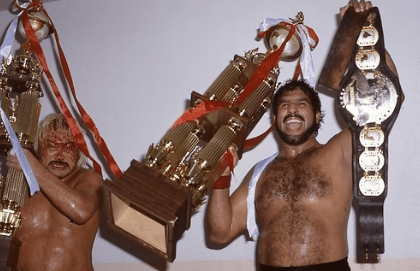
In 1976, Ueda joined the AWA-affiliated International Wrestling Enterprise in Japan. In June, he became the world champion after defeating Rusher Kimura. He held the belt for two months before vacating due to a kayfabe injury.
In 1977, he made his first appearance in his decade-long off and on-again tenure in New Japan.
In NJPW, he became perhaps the most hated Japanese native in the country, teaming with the feared gaijin heel Tiger Jeet Singh and standing out due to his large frame and dyed blonde hair. His hair was a distinctive feature of Ueda, with one fan recalling: “few looked more badass then Ueda with his bleached hair and nasty Yakuza-like grin on his face.”
The duo, who were North American tag champions for half a year, were described as the nation’s “top heel tag team” in John Molinaro, Jeff Marek, and Dave Meltzer’s Top 100 Pro Wrestlers of All Time.
Behind the scenes, Singh and Ueda became good friends. Ueda paid for meals, helped Singh navigate the Japanese language, and served as protection after Singh accosted members of the Yakuza. Once, after Ueda was fired for a fight, Singh got him rehired. As Singh remarked: “Anywhere I went, I had Ueda with me all over the place.”
In April, the two had a noted outing against Saiji Sakaguchi and Antonio Inoki, with Lou Thesz serving as the special guest referee.
Reflecting their real-life animosity, Ueda had some matches against Inoki, including a nail floor death match in February 1978. It reportedly made 14 million yen in same-day sales, six times the amount an even big market show would usually draw.
That same year, Ueda won the Tokyo Sports Awards’s Popularity Award. It would go on to be won by Japanese icons Terry Funk (1979), Tiger Mask (1981), and Giant Baba (1988).
Ueda was a main event fixture, often facing down famous names like Inoki, Riki Choshu, and Tatsumi Fujinami. He faced opponents as diverse as Chief Jay Strongbow, El Canek, Bad News Brown, Mil Mascaras, Ox Baker, Ricky Steamboat, Bret Hart, Marty Jones, Nikolai Volkoff, and Andre The Giant.
All Japan

In 1981, Ueda jumped to All Japan. This was a major coup in a promotional war between the two, with the defection triggered by Tiger Jeet Singh’s opposition to NJPW signing Abdullah The Butcher.
Giant Baba, Stan Hansen, and Jumbo Tsuruta all battled with the blonde-haired hoss, while Ueda even stood across the ring from WW(W)F great Bruno Sammartino.
In 1981, Ueda and Singh entered the World’s Strongest Tag Determination League, earning victories such as the Funks, Harley Race and Larry Hennig, and Ashura Hara and Genichiruo Tenryu. They came third with 10 points. In 1982, Ueda teamed with the Super Destroyer, Bill Irwin under a mask, and came last with zero points.
1983 saw “The Golden Wolf” win his final title, teaming with Singh to defeat Giant Baba and Jumbo Tsuruta for the International Tag Team titles, though they quickly lost them back a week later.
Perhaps the most notable aspect of Ueda’s run however was in his personal life. After a show in Kumamoto, Ueda went to a snack shop where he met and started a relationship with future wife Emiko.
Back in New Japan

[Ueda fights Akira Maeda]
After his one and only appearance in the UWF on their first card, Ueda returned to New Japan, competing in the January 1st 1985 New Year Golden Series.
In New Japan, he would often team with the likes of Inoki and Fujinami and later the Japanese Kendo Nagasaki, with notable solo bouts against Abdullah The Butcher, Andre The Giant, and the freshly-released WWF star David Schultz who had been the talk of the wrestling world months earlier after slapping John Stossel.
In 1986, he competed in a 10-man NJPW vs UWF gauntlet match in which he tagged with Inoki, Hoshino, Takada, and Kimura.
During this time, he used the theme “Spartan X” the theme from the Jackie Chan film Wheels on Meals, long before the song was more famously used by… Mitsuhara Misawa.
Solo success was limited as he was in the bottom half of the NJPW 1986 IWGP League and performed worse in 1987.
In 1987, Ueda took a break from the ring to help wife Emiko run her restaurant and took to promoting his own local shows. He also had time to make a memorable TV performance…
Takeshi’s Castle

Having already had acting credits to his name, such as his role in cult underground film Burst City, a dystopian punk rock musical and action film showcasing various Japanese punk bands, directed by Gakuryu Ishii.
In episode 13 of the classic Takeshi’s Castle, aired in September 1986, the blonde-haired bruiser made his first appearance, competing in the game Sumo Rings. Ueda, a former sumo wrestler, would go on to make a total of eight appearances in Sumo Rings, splitting him time between the green and blue rings.
He would also appear in several other games. He played a “black handed, blackhearted guard” in Honeycomb Maze, tackled unwitting contestants in Grid Iron, and launched cannonballs at Bridge Ball players.
Blondie made his final appearance in episode 108, aired in October 1988.
Return and Final Years

[Ueda back in the mid-70s]
In 1992, after four and a half years out, Ueda made one final foray into NJPW. It was a reunion for Takeshi’s Castle cast members as one of his opponents was Strong Kobayashi, who played the face-painted guard Strong, inseparable from Kobaji in the show.
He followed this with a run in the Japanese Network of Wrestling (NOW). Here, he reunited with Tiger Jeet Singh and faced names such as Bob Orton and Manny Fernandez.
His most memorable match was against Ishinriki in an Anything Goes Anywhere bout. The half-an-hour bloody brawl saw “The Golden Wolf” Ueda lose but the match has received acclaim, with 12 Cagematch ratings — none below an 8.
In 1995, Emiko was diagnosed with colon cancer. The next year, though Emiko was against it, Ueda returned to the ring.
Ueda would have a stint in the IWA in 1996, the promotion that had gained international infamy for its King of the Deathmatch tournament the previous year. Here, he wrestled Tarzan Goto and Mr Gannosuke, both of whom would model their blonde hair after the innovative “Golden Wolf”.
In his final match, Ueda defeated Keisuke Yamada in a thumbtacks match in front of 2,550 fans at the Prefectural Sports Center in Miyagi.
The Accident and The Aftermath
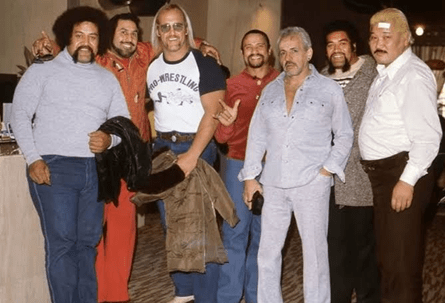
Shortly after his match against Yamada, Ueda was on the road.
Wanting to uphold kayfabe, he travelled in a private car rather than take the coach with the rest of the wrestlers. During a trip, he was rear-ended by a semi-truck.
The driver is said to have died immediately while Ueda was propelled through the windshield, careening onto the asphalt road.
The event left Ueda in a wheelchair, paralysed from the neck down. His lungs had also been reduced to a third of their previous capacity.
After his forced retirement, NJPW hosted a tribute show in his honor in April 1998 in Kumamoto. 2,500 fans witnessed the event, which featured a main event of Genichiro Tenryu teaming with Heisei Ishingun (Tatsutoshi Goto, Michiyoshi Ohara, and Shiro Koshinaka) against NWO Japan, featuring Masahiro Chono, Hiro Saito, Hiroyoshi Tenzan, and Big Titan.
Ueda moved with his wife to Emiko’s hometown of Usuki and opened a thrift shop.
Ueda eventually became well enough to gain feeling in his upper body. He would go on to deliver public speaking engagements, visited an orphanage, and volunteered with an organisation that held pottery classes for children with Downs syndrome.
In 2011, a 71-year-old Ueda died from asphyxiation.
Legacy

[Toru Yano, whose blond hair is a clear tribute to Ueda’s pioneering look]
Ueda may not be the most famous Japanese name but there can be little doubt of his significance. Much of his legacy is still visible to this day.
For example, his look alone has been much imitated. The stark blonde hair on the tall, large frame has made him an icon and been copied by stars like Toru Yano and, to an extent, EVIL. For his role as one of the first major native heels, Ueda’s reinvention has been described as “a genuine watershed moment in the development of puroresu.”
His shoot, brawling wrestling style, akin to that of Abdullah The Butcher or Bruiser Brody, has become more custom for those of a similar frame.
And thirdly, without his infamous ‘betrayal’ of Inoki during the JWA days, there is a question as to if New Japan and All Japan, the two biggest promotions in the nation, both of which are still in existence to this day, would ever have come to fruition.
Despite his hefty reputation though, which helped establish a famous guise, cement a brawling hoss style, and incidentally create the mainstream Japanese wrestling industry as we know it, he will probably be best known to most as “the blonde one from Takeshi’s Castle.”
