Posted on by bdamage1

Brian Damage
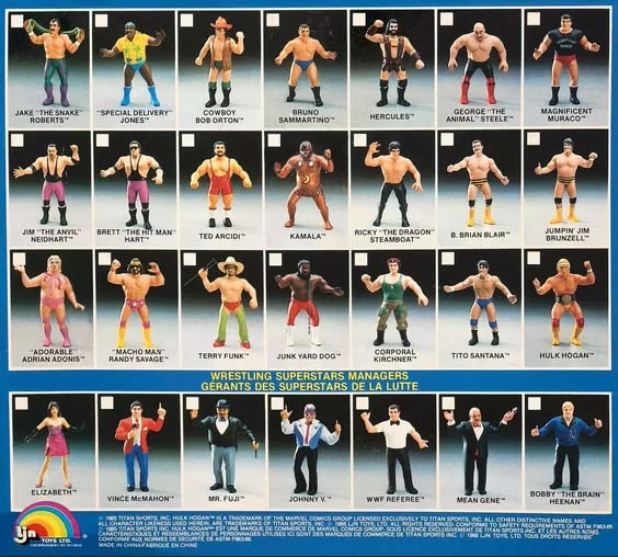
As the World Wrestling Federation was expanding nationally in the early 1980’s, WWF owner Vince McMahon was continually looking at other ways to help grow is business. McMahon noticed that the 80’s saw a boom in action figures. From the likes of the Transformers, He Man and GI Joe…action figures were bringing in millions of dollars worldwide. Vince decided to get the WWF in that market and partnered with the toy company LJN in 1984.

At the time, LJN was reeling financially from licensing a series of toys based on the motion picture Dune. The movie was a box office flop and nobody bought the line of Dune figures. LJN took a proverbial financial bath with all the money lost on that agreement. Enter Vince McMahon and the WWF, who were looking to create their own line of action figures based on their wrestlers. LJN was skeptical at first, but after several meetings with McMahon and seeing the explosion in popularity with the company appearing with the likes of Cyndi Lauper and Mr. T and also showing up on MTV…LJN agreed to license WWF action figures.

Initially, the figures were only supposed to be 3.75 inches tall. LJN sent Vince McMahon a larger scale model that was 8 inches tall, to show him the detail of what the smaller version would look like. The problem was, Vince fell in love with the look of the larger scaled model and demanded that the WWF dolls should be 8 inches tall instead of the agreed upon 3.75 inch dolls. He felt that the larger dolls better captured what a WWF superstar was…larger than life. So LJN went to work on what the new version of the WWF action figures would resemble.

The first line of official LJN WWF action figures debuted in the spring of 1984 and were named ‘Wrestling Superstars.’ The line consisted of wrestlers Hulk Hogan, Roddy Piper, Andre the Giant, Big John Studd, Hillbilly Jim, The Iron Sheik, Nikolai Volkoff, Jimmy “Superfly” Snuka, and the Junkyard Dog. The Wrestling Superstars were made of heavy rubber and the packaging also included a poster. The toys were an immediate smash hit with consumers. The first round of Wrestling Superstars toys generated an estimated 4 to 5 million in sales.

The LJN and WWF team would meet consistently afterwards and go over new stars to make action figures of. McMahon would let the toy company know what wrestlers were expected to be big stars in the upcoming year and then together select the next batch of figures to create. The WWF wrestlers would then be made available to appear at the annual toy fair in New York City to schmooze with potential buyers. Some WWF stars would receive a flat rate for all the action figures they sold within the calendar year. While some received upwards of 15,000 dollars, others like Hulk Hogan would get much more than that.

The partnership between LJN and the WWF lasted from 1984 until 1989. It was LJN that decided to pull the plug on their team. With video games becoming more and more popular, LJN made the decision to get involved in the gaming business and the WWF partnership was severed. In total, LJN produced over 64 different WWF action figures.

The end of the LJN partnership certainly did not mean the ending to the WWF making action figures. They continue to produce them to this very day. They are less cartoonish and more detailed than ever before. Yet, there was something so very special about the LJN line of toys that still resonate with fans young and old. Some of the more rare WWF LJN dolls are worth a bundle of money. There was simply more nostalgia attached to those figures, no matter how advanced the look and details into the newer models.
