
Griffin Kaye
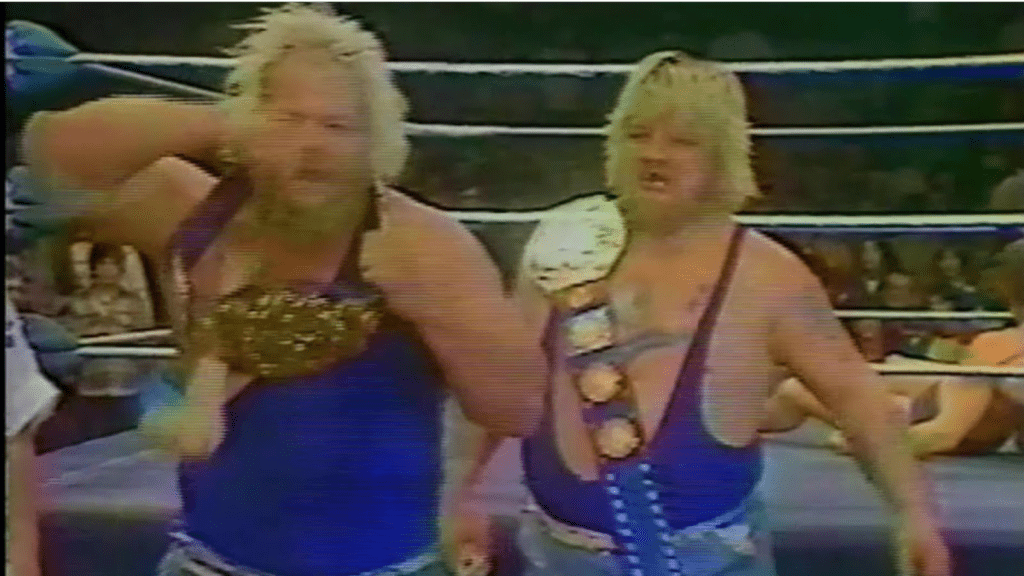
(Photo: ‘Wrestling Memory Grenade’ on YouTube)
From Mayor of Knox County Kane to Finnish Parliamentarian Ludvig Borga to Japanese Cabinet minister Hiroshi Hase, politicians and wrestling have long been intertwined across the world. Canada is no different, as evidenced by the bizarre and short-lived Canadian Extreme Wrestling Party – an organisation that tried to send a Moondog to Parliament.
Origins
The party were inspired by Jesse Ventura’s successful independent campaign for Minnesota governor. (Photo: Axios)
The CEWP was founded in 1999, on the back of Jesse Ventura’s surprise election as Governor of Minnesota. “The Body” had won the gubernatorial race not only as a third party candidate for Reform but prevailed over seasoned major party candidates in what the New York Times referred to as an “Earth-rattling political upset.”
The party’s interim president Adam Peddle (a 20-year-old store clerk by day and wrestler Jason the Terrible by night) told reporters: “We saw how unhappy voters like the nurses and pensioners were after the same old crowd got re-elected, and we thought we could do better. Then we said to ourselves, `If Jessie (The Body) Ventura can get elected governor of Minnesota, so can we.’”
The party held its leadership convention in Conception Bay South, the first leadership convention any party has ever had in Newfoundland.
In a display of the party’s pageantry, their leader was nominated via an 11-man battle royal.
In making this piece, I spoke with CEW top performer and longest-reigning world champion “Dirty” Don Martini, who explained: “They wanted to get someone who was young, educated and well-spoken with a political mind to be leader of the party to help give it credibility. So, in classic wrestling fashion, they had a battle royal to determined who would be leader. The winner was my future tag partner Quentin Barboni (who was wrestling under the name Pagan at the time). Management pushed for him to win and therefore get involved but Quentin hated the idea of it so he backed out of it pretty quickly afterwards.”
Barboni was a high-profile performer for Cutting Edge Wrestling, which started in 1998, holding cards including Extreme Heat, Downtown Thunder, and Christmas Chaos.
Though wrestlers entering politics seem to be disproportionately right-wing, the Canadian Extreme Wrestling Party was decidedly left-wing, with policies including withdrawal from NATO and a guaranteed annual income. In the book (Un)Controlled Chaos: Canada’s Remarkable Professional Wrestling Legacy, author Vance Nevada notes that the agenda was shaped by the existing policies of the Green Party, edited by future Green Party leadership contender Jason Crummey.
This serious program sets the Canadian Extreme Wrestling Party apart from many other ‘joke’ political parties such as Britain’s infamous Monster Raving Looney Party or Canadian’s Rhinoceros Party.
Cometh the Man, Cometh the Moondog
WWF tag team The Moondogs, with Ed “Sailor” White on the right. (Photo: Pro Wrestling Stories)
The Cutting Edge Wrestling star Ed “Sailor” White would be the party’s most influential member, contesting the 2000 St. John’s West by-election.
White is perhaps best remembered for portraying Moondog King in the classic WW(W)F tag team The Moondogs.
Brought into the World Wide Wrestling Federation by “Captain” Lou Albano in 1980, King and Moondog Spot (Randy Colley) portrayed two unpredictable, rabid Appalachian mountain men. Their messy, unkempt, bleached blonde hair, wild facial expressions, and constant wielding of dog bones gave them one of the most distinctive looks of the era.
In March 1981, the Moondogs defeated Rick Martel and Tony Garea to win the WWWF World Tag Team titles in Allentown, Pennsylvania. As well as tag success, King had some notable solo outings including a Madison Square Garden bout against Mexican sensation Mil Mascaras.
The success was short-lived for King, who – due to prior criminal convictions – found himself unable to re-enter the United States when trying to recross the Canadian border. He believes he was stopped at Champlin, with his passport confiscated, as a result of sabotage by a rival promoter.
King would be replaced by Moondog Spot, played by Larry Latham after his recommendation by Andre the Giant, continuing the Moondog name but ending King’s American career. Irritatingly for King, the Rex/Spot combination is probably the more memorable team, with the team lasting into the ‘rock and wrestling era’ boom.
All three Moondogs would team up for the only time next year during a tour of South Africa. White witnessed several sell-outs during his time in South Africa, including drawing 18,000 to Durban in late 1981. One edition of Wrestling Training Illustrated wrote: “the sport of wrestling has never seen anything like the Moondogs when they hit South Africa.”
On WW(W)F TV, Albano commented King had been injured after chasing a car, a bizarre cover story considering wrestling’s first Moondog, Moondog Mayne, was legitimately killed in a car accident just three years earlier.
Although best known for his run under Vincent J. McMahon, King had long been associated with the Canadian wrestling scene.
Indeed, the St. John’s-born performer debuted in 1972 under promoter Larry Kasaboski, wrestling for Stu Hart’s Stampede Wrestling shortly thereafter. Canadian success led him to Japan where he competed for the IWE and AJPW among others, sharing the ring with the likes of Jumbo Tsuruta and Giant Baba.
After Japan and his aforementioned stint in Connecticut, White landed back in Canada, working in Quebec and facing off against top Canadian names such as Edouard Carpentier, Dino Bravo, and Pat Patterson. He reportedly left the territory after a run-in with Billy Robinson ended with a drunken Robinson knocked out and urinated on by “Sailor”.
The Great White in The Great White North
After the Billy Robinson incident, White remained in Canada but moved back to Newfoundland. It was here he crossed paths with several Canadian stars of the 1990s such as Bruiser Bedlam and Robert Maillet (Kurrgan).
However, during this time, his marriage broke down, and the subsequent divorce seems to have sent White down a road of alcohol and drug abuse. He regularly ran up a $500 nightly tab and became addicted to cocaine, LSD, and heroin, one source notes.
Over the next few years, he was in and out of prison, for crimes including drug possession, drug trafficking, and pimping prostitutes, wrestling journalist Greg Oliver notes. He also served time for assaulting his ex-wife, something he called a low point, where he was “lonely, empty, and afraid to face the realities of life and death.”
However, in 1989, he became a born-again Christian, turned his life around, and became a dedicated member of the Salvation Army. He also reportedly ran a bar after his return to Newfoundland.
The road was not so smooth for Moondog however, who lost $40,000 in trying to get an All-Star Wrestling promotion off the ground.
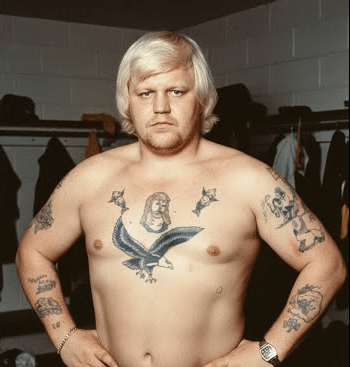
He would also join the upstart Cutting Edge Wrestling, becoming a common face on the promotion’s cards of the late 1990s. He had long had a reputation as a hardcore wrestler, epitomised by his 26 tattoos, missing teeth, and penchant for blading, as taught to him by Abdullah the Butcher.
By the year 2000, he was living on benefits, stating: “I don’t have a cent. I’m living on welfare and sick of it.”
A Seat Opens For A Sailor
Canadian MP Charlie Power, who represented the seat of St. John’s West. (Photo: OurCommons.ca / Wikipedia)
On January 31st 2000, incumbent Progressive Conservative Member of Parliament Charlie Power resigned his St. John’s West seat.
Though “personal reasons” were cited at the time, Power had also had disagreements with party leader Joe Clark, criticising the Tory leader’s stand on national unity and inability to re-enter government (the party had been in government prior to 1993 when they fell from government to just two parliamentary seats and remained the fifth biggest party in the years since and losing ground to fellow right-wing party Reform).
Power was accused by his own executive assistant of trying to help the Liberals, a claim only amplified when, seven months later, Power landed an $80,000-a-year job under the Liberal Minister of Veterans Affairs.
Aside from the controversy of the departure, Power’s exit created an open parliamentary seat and, after some convincing, the passionate activist White ran for the St. John’s West riding (the Canadian term for a parliamentary seat or constituency).
Of note, although much of the press furor around the campaign stated White ran for the Canadian Extreme Wrestling Party, the party was never successfully registered with Elections Canada, the body overseeing Canada’s electoral processes. Instead, ballot papers merely read “Independent” next to White’s name.
I was unable to find out why but Elections Canada notes everything from an invalid or no nomination paper, no official notification of party endorsement within 48 hours, and the need for an official agent or auditor can all be barriers to entry.
White was not the first wrestler to try to crack the Canadian parliament. “Whipper” Billy Watson – the man credited with the first ever televised world title win – ran in the 1965 Canadian election for the Progressive Conservatives in York East, though fell some 3,500 votes short of the winning Liberal candidate.
Moondog, the Underdog
The St. John’s West seat had long been a Tory stronghold, with Progressive Conservative and high-profile Cabinet minister John Crosbie holding down the seat for many years. (Photo: CBC)
White’s candidacy was always an uphill battle, especially since the St. John’s West seat was a Tory stronghold, with the party holding it for 37 of the 51 years since Newfoundland joined Confederation. From 1979-1993, it was held by Cabinet minister John Crosbie, who held posts such as Finance Minister, Justice Minister, and Transport Minister.
Nonetheless, Sailor White did get some national attention, primarily because in early polling, he outperformed the Canadian Alliance (a party created by a merger of right-wing parties including Opposition party Reform).
Much of Sailor White’s campaign was documented and preserved by the local St. John’s Telegram paper.
In running for Parliament, White said he had a bone to pick (pun intended) with mainstream politicians, calling them “wimps”, adding: “There are too many people who are afraid to speak up and don’t get things done for their ridings. I want to see a change in that.”
His platform focussed primarily on two things: free fishing and opening a youth centre.
On the fishing issue, White supported subsidies for land-based swilers (Newfoundland seal hunters) and the development of seal oil products.
He told The Newsfoundland Herald: “We should be able to get in our boats at any time; we’ve got the God-given right to go out and get a fish any time we want. When I get to Ottawa this is what I’m going to be fighting for. I’m going to represent Newfoundland to the best of my ability, I’m going to stand up for Newfoundland and I’m going to wear the Newfoundland flag.”
He had promoted this further through a press conference in which “Sailor” slammed a faux Austrian fisherman through a table.
“Sailor” was also keen on opening a youth centre, something he had advocated long before entering politics. He dreamed of opening the Sailor White Youth Centre as a way to help the youth.
He told Slam! Wrestling: “I believed in the issues. I got tired. I’ve been trying to get a youth centre going and I got tired of getting the runaround. So I thought maybe if I get into the election, I thought that I’d have a chance to speak my piece, get the word out that I’m trying to get a youth centre and also something to help the senior citizens.”
One piece says that this was fueled by “Sailor”’s own harsh upbringing. The future Moondog left school at the fifth grade, left home young and led “a life on the edge of both law and morality.”
The outlaw wrestler campaigned on the slogan “Parliament needs a Moondog”.
The Canadian Broadcasting Company (Canada’s equivalent to the BBC) even tried to organise an event where Sailor White met with Jesse Ventura, though these plans never came to fruition.
Size of the Fight in the Dog
Progressive Conservative Loyola Hearn, who won the seat and far outpolled “Sailor” White. (Photo: Globe and Mail)
On May 15th, voters in St. John’s West went to the polls to decide their representative.
Unsurprisingly, the Progressive Conservative Party, who had long held the seat, hung on as Loyola Hearn kept the seat Tory blue. What was more surprising was its competitiveness, with NDP candidate and TV comedian Greg Malone running just 356 votes short out of the 32,107 votes cast (a 1.1% margin of victory).
Less surprising was Ed Sailor White’s performance, finishing fifth with 332 votes (just over 1% of the vote).
Despite unfavourable early polling, the Canadian Alliance pulled ahead of White, avoiding a national embarrassment. As The Globe and Mail wrote: Just think what a Newfie joke that would have been had the candidate of the Official Opposition been outpolled by the candidate for the Extreme Wrestling Party. As Wellington said of the Battle of Waterloo, it was a damn close-run thing — 1,317 votes for Mr. Hall to 328 for Sailor White.”
For his part, White was proud of his result, noting how he managed over 300 votes on $100 and just two volunteers knocking on doors and putting up posters.
He remained magnanimous in defeat, showing up at Tory headquarters to concede defeat to Mr. Hearn, leading to impromptu “Sailor! Sailor! Sailor!” chants from party activists.
The biggest takeaway from the election for the national media was the screeching loss of momentum for the nascent Canadian Alliance party.
Though beating “Sailor” White, their vote tally’s proximity to the kooky outsider was framed by opposition parties as a sign of faltering party.
Though unknown at the time, in the federal election later that year, the Alliance would finish second – quite a distant second at 66 seats to the Liberals 172. This meant the party that would be the official Opposition within a year were only a hop, skip, and a jump away from a rogue ex-wrestler.
As Tory leader Joe Clark remarked, “If there was any proof needed, it’s crystal-clear tonight that this Reform party [Canadian Alliance] is a party that has no reach beyond Western Canada, nothing at all of national party. I guess if they want to form an alliance with anybody, they should take a close look at the Extreme Wrestling Party.”
Speaking in the Canadian House of Commons, NDP MP Lorne Nystrom noted: “Mr. Speaker, I know the Canadian Alliance finished with 4% in Newfoundland slightly ahead of the extreme wrestling party. That tells how much credibility it has on healthcare.”
A more bizarre exchange in the Nova Scotia legislature saw Frank Corbett state that members of the Alliance including Assembly members Brooke Taylor, Tim Olive, and David Hendsbee instead flock to the Canadian Extreme Wrestling Party and take on the ring names Bruiser Brooke, Mad Dog Olive, and Dancing Dave. I’m sure that’s both a cutting and hilarious slam for fans of the niche Nova Scotian local political scene.
Politics After the CEWP
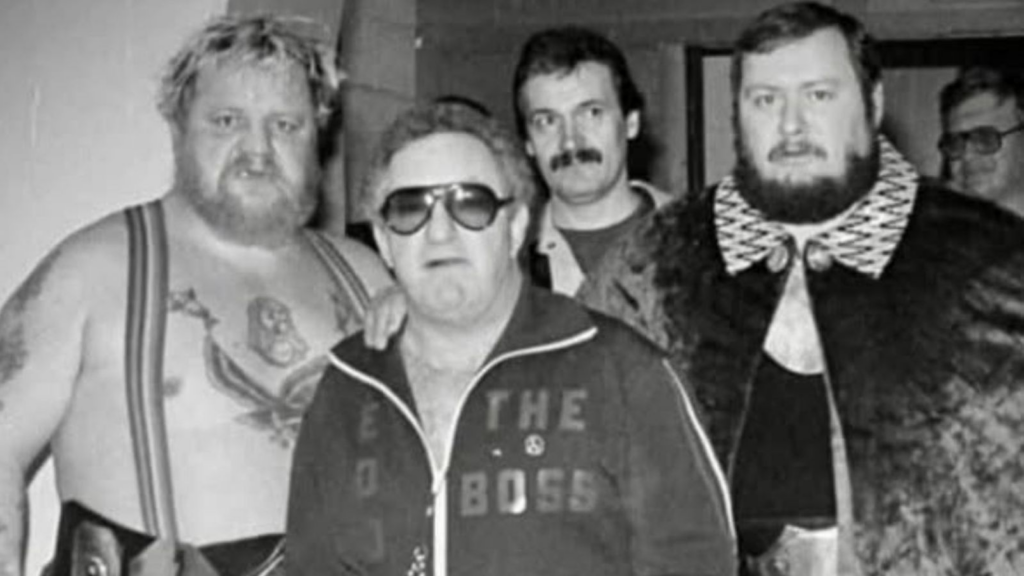
“Sailor” White (far-left) during his wrestling years, with manager Eddie “The Boss” Creatchman and wrestler Gilles Poisson. (Photo: ‘Today in Pro Wrestling History’ on Facebook)
The loss did not damage “Sailor” White’s political resolve, with King indicating his intention to stand again: “If there’s a city election first, I’m going to run for councilor at large and get on the city council.”
At the next federal election, “Sailor” tried his luck again. This time, he dropped the Canadian Extreme Wrestling Party and ran for a more conventional third party, running for the Green Party in the Bonavista-Exploits seat.
A big coup for the party, local press noted how White was a bigger name than even Green Party leader Jim Harris. Organiser of the Newfoundland and Labrador Green Party Lori-Ann Martino praised the Moondog, stating: “White’s candidacy with the Greens was not about celebrity endorsement. It was about a shared desire to be heard, a shared understanding of values and an expressed concern to improve Newfoundland and Labrador’s present and its future.”
Despite this, The Western Star referred to the Bonavista-Exploits by-election as “low key”.
Sailor did not fair much better than 2000, polling 367 votes (1.1% of the vote). Unlike 2000 however, he finished fourth not fifth and even beat one candidate, winning 23 more votes than independent John Lannon.
The History of Cutting Edge Wrestling
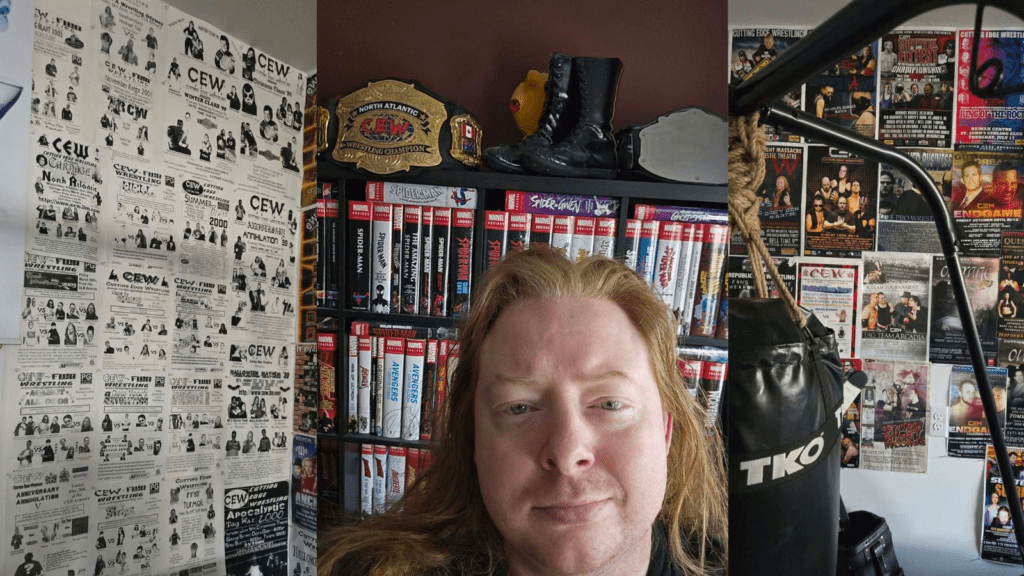
Some photos of CEW memorabilia shared with Ring the Damn Bell! by performer “Dirty” Dom Martini.
As for Cutting Edge Wrestling, the show continued promoting events from 1998 until 2008.
At the time of White’s first parliamentary run in 2000, Martini told me that business for CEW was gangbusters, not necessarily due to the political party but grassroots organising, establishing a clear identity, and growing their support base.
As noted in 2022’s (Un)Controlled Chaos: Canada’s Remarkable Professional Wrestling Legacy, author Vance Nevada writes that the original CEW went under as “with the challenge of rising costs and with no significant financial means held by any single leader or consortium, the organisation had struggled to maintain visibility for several years.”
The book quotes one of the company’s contributors who bemoans: “Cutting Edge Wrestling was a collective of people pulling money together in a non-secure fashion with no real office or direction.”
It would relaunch in 2010, running their first event as the revamped brand the next year. With the money drying up in 2008, hence the end of its original run, a series of financiers helped prop up the promotion after its return. “Dirty” Don Martini, who told me he was responsible for maintaining the promotion in its last few pre-Covid years.
Contacting the company through social media and email, their spokesperson told me they reestablished themselves as “a group of folks here (including co-founder Vince Austin) wanted to embrace the history of Newfoundland wrestling and keep what Sailor White had established alive.”
They added: “Our motivation was to offer what had been missing. Newfoundland wrestling for Newfoundlanders – where the money was made here and primarily kept here as a focus. (That doesn’t mean we didn’t utilize talent from other areas. But the goal was to invest in our people).”
In regards to the latter point, advertising materials indicate that more international and famous names like Sabu and Tommy Dreamer also worked for the promotion, beefing up supercards such as 2013’s Outrage and King of the Rock.
Indeed, the company presented itself as largely a hardcore promotion, putting on hard-hitting, strong style matches, with the slogan “Wrestling that leaves a mark!”.
As Martini told me, in the original CEW, “Sailor” White would often yell “harder!” at the rookies as they performed punches or chops. He adds: “My very first match was a King of Hardcore match. I was 16 years old, so needless to say that was the vibe of the early years … By the time CEWs rebirth came around it was one of the most well produced local products that’s ever existed. A nod to the hard-hitting style of the past but with a modern age in-ring professionalism that had always been lacking locally.”
They ceased events during the pandemic, with their last show, Smashin’ Tables, taking place in March 2020.
At the time, the promoter Travis Canning, once the primary funder of Cutting Edge Wrestling, was also the owner of New Evolution Wrestling, which he founded in 2015. Only able to promote one company, he opted to continue with his fledgling NEW promotion.
Moondog’s Last Years
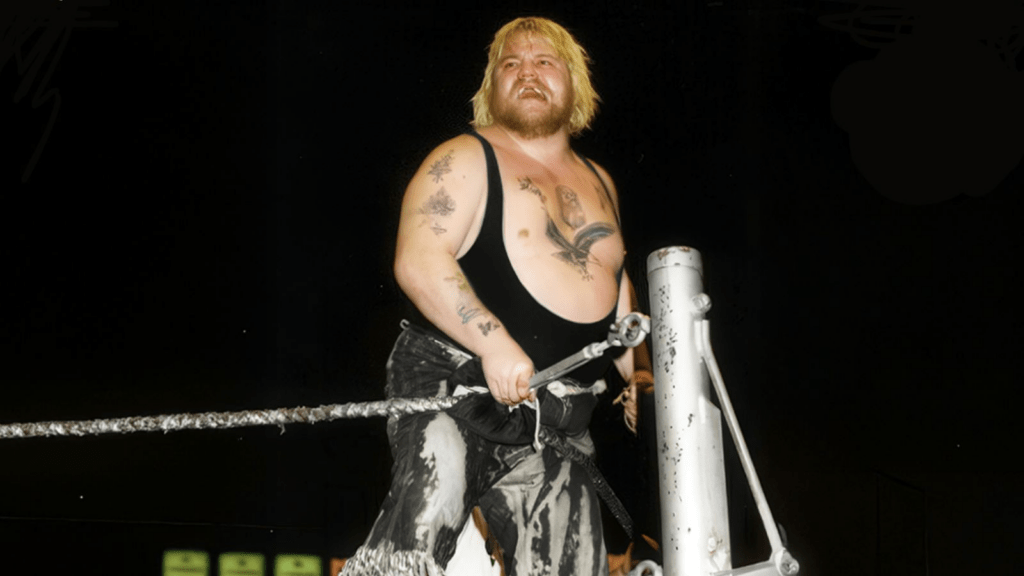
Press from his 2000 campaign stated “Sailor” White retired the previous year due to complications from diabetes but data from wrestlingdata.com indicates he wrestled his final bout in September 2000.
Retiring after a storied 25-year career, The Globe and Mail reports that the Moondog wrestled over 2,500 matches and won 23 championships.
His diabetes cost him three toes on his right foot. In 1999, he had an attack of Bell’s palsy that left half his face paralysed. An additional blockage in his left could not be resolved.
Having previously had two heart attacks, White underwent a triple bypass in 2002.
In 2004, White was involved in a life-changing car crash. As The Globe and Mail wrote: On a rainy day in December, within hours of starting a new job as a driver for Executive Taxi in St. John’s, his cab hydroplaned and crashed. Firefighters had to use the Jaws of Life to extract him … His teenage passenger was unhurt, probably because he was shielded by Mr. White’s massive body.” As a result, he broke two bones in his neck and pinched a nerve in his spinal cord.
Despite the devastation, White hung on for eight months, in hospital and on life support, until August 2005.
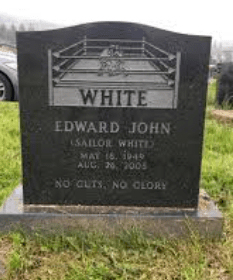
His funeral mass was held on August 29th at the St. John Bosco Church. Slam! Wrestling notes he was survived by daughter Rozlynn, grandson Keygan, sisters Mercedes Murphy (Thomas) and Jean Simms, and brothers David (Valerie) and Paul (Lara).
Cutting Edge Wrestling hosted a memorial show for White in 2005 in conjunction with Northern Championship Wrestling (NCW) out of Montreal.

David Fullam
Sailor White ware truly different. Not sure if that was good or bad.